


Family Visas in Australia: Complete 2025 Guide
Learn everything about Family Visas in Australia in this 2025 guide — including types, eligibility, costs, processing times, and expert tips for a successful application.
Introduction to Family Visas
Australia is renowned not only for its stunning landscapes but also for its strong commitment to **family reunification**. The Family Visa Program allows Australian citizens, permanent residents, and eligible New Zealand citizens to sponsor close family members to live, work, and study in Australia.
Family visas are designed to strengthen family bonds by reuniting spouses, parents, children, and dependent relatives. Whether you’re married to an Australian citizen, planning to bring your parents, or reuniting with your child, a specific visa pathway is available to help you achieve that dream.
Key Benefits of Family Visas
- Long-term residency opportunities for family members.
- Access to **employment and education**.
- Pathway to **permanent residency** and, eventually, citizenship.
- Eligibility for healthcare through **Medicare**.
- Emotional and financial stability by reuniting families.
Types of Family Visas Available
Partner & Prospective Marriage Visas
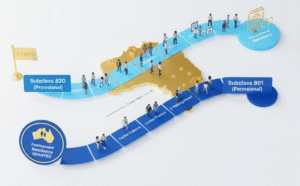
Partner Visas (Subclasses 820 and 801)
- For **spouses or de facto partners** of Australian citizens or permanent residents.
- **Subclass 820** is temporary; **Subclass 801** is the subsequent permanent visa.
- Applicants must provide solid evidence of a **genuine, continuing relationship**.
Prospective Marriage Visa (Subclass 300)
- Allows **fiancés** to travel to Australia, marry their partner, and later apply for a Partner Visa.
- A temporary **nine-month** visa.
- Must be outside Australia when applying.
Parent & Child Visas
Parent Visas
- **Contributory (Subclass 143):** Faster processing but **higher cost**.
- **Non-Contributory (Subclass 103):** Lower cost but **significantly longer processing time**.
Child Visas (Subclasses 101 and 802)
- Allows **dependent children** of Australian citizens/PRs to live in Australia permanently.
- **Subclass 101** is for children outside Australia (Offshore).
- **Subclass 802** is for children already in Australia (Onshore).
Also available: Remaining Relative, Carer, and Aged Dependent Visas for specialized circumstances.
Eligibility Requirements
Sponsor Obligations
To sponsor a family visa applicant, the sponsor must generally:
- Be an Australian citizen, permanent resident, or eligible New Zealand citizen.
- Be **18 years or older**.
- Have a **clean character record**.
- Commit to **supporting the applicant** financially and socially.
Relationship Proof Criteria
For partner visas, convincing relationship evidence is crucial:
- **Financial:** Joint bank accounts, shared leases/property.
- **Social:** Joint invitations, statutory declarations (Form 888) from friends/family.
- **Household:** Shared living arrangements, joint responsibility for children.
- **Commitment:** Relationship history statements, future plans.
Processing Times & Visa Fees (2025 Update)
Average Processing Times
| Visa Category | Average Processing Time |
|---|---|
| Partner Visas (820/801) | **18–25 months** (two stages) |
| Child Visas (101/802) | 10–18 months |
| Contributory Parent Visas (143) | 4–6 years (Faster queue) |
| Non-Contributory Parent Visas (103) | Significantly longer (**12+ years**) |
Processing times are highly variable based on application quality and government quotas.
Updated Visa Fees (2025 Base Charges)
| Visa Subclass | Base Fee (AUD) |
|---|---|
| Partner Visa (820/801 & 309/100) | ~AUD 8,850 |
| Prospective Marriage Visa (300) | ~AUD 8,500 |
| Parent Visa (Contributory Base Fee) | ~AUD 4,765 (plus high second instalment) |
| Child Visa (101/802) | ~AUD 2,800 |
Source: Australian Department of Home Affairs. Additional applicant charges and government indexation apply.
Common Reasons for Visa Refusal
Avoid these common pitfalls to ensure a smoother application process:
- **Insufficient Relationship Evidence:** The most common cause. Documentation must be credible and consistent across the four pillars (Financial, Social, Household, Commitment).
- **Health or Character Issues:** Failure to pass medical examinations or not fully disclosing criminal history.
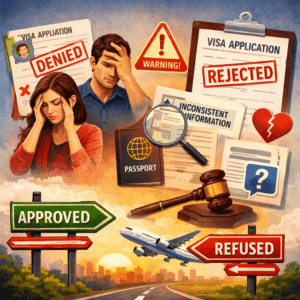
- **Incomplete or Inaccurate Applications:** Simple errors, missing documents, or inconsistent information can lead to significant delays or outright denial.
Start Your Family’s New Chapter in Australia
Our MARA-registered agents specialize in complex family cases. Let us build a strong, compliant application for you.
External Link: Learn more on the official Australian Department of Home Affairs Family Visa page.
FAQs on Family Visas
1. How long does a Family Visa take to process in Australia?
Processing times vary — Partner Visas average 18–25 months, while Contributory Parent Visas can take several years. The quality of your documentation is a major factor.
2. Can I work while waiting for my family visa to be processed?
Yes, most Bridging Visa holders (granted after application submission) are allowed to work and study while their application is in process.
3. Do I need to live in Australia to sponsor a family member?
Yes, sponsors must be living in Australia or show clear evidence of their intention to return permanently to reside in Australia when the visa is granted.
4. Can same-sex partners apply for a Partner Visa?
Absolutely. Australian immigration law recognizes same-sex marriages and de facto relationships equally for all partner visa purposes.